
Bearing Failure Diagnosis: A Practical Guide for Industrial Maintenance Managers
An inspection by eye leaves most hidden reasons for a bearing death undiscovered. Crews tend to explain a failure from what they can see on the surface, while tiny misalignment, cracks growing under the raceway, and broken-down lubricant slip past unnoticed until the next unplanned shutdown.
Working through three analytical stages cuts unplanned downtime sharply and stops the repeat from happening. Joining ISO-standard inspection practice to a proper root cause investigation locates the real trigger instead of treating symptoms; pair that with a replacement chosen for the true duty, and recurrence falls away.
I once flew to a Brazilian steel mill that was consuming conveyor bearings every few months. The grease was blamed first, then the housing, then anything else within reach. But the failed units laid out on the bench carried the classic asymmetric spall of a bent shaft throwing a bearing out of line. Once the crew worked from the modes instead of guesses, the breakdowns stopped.
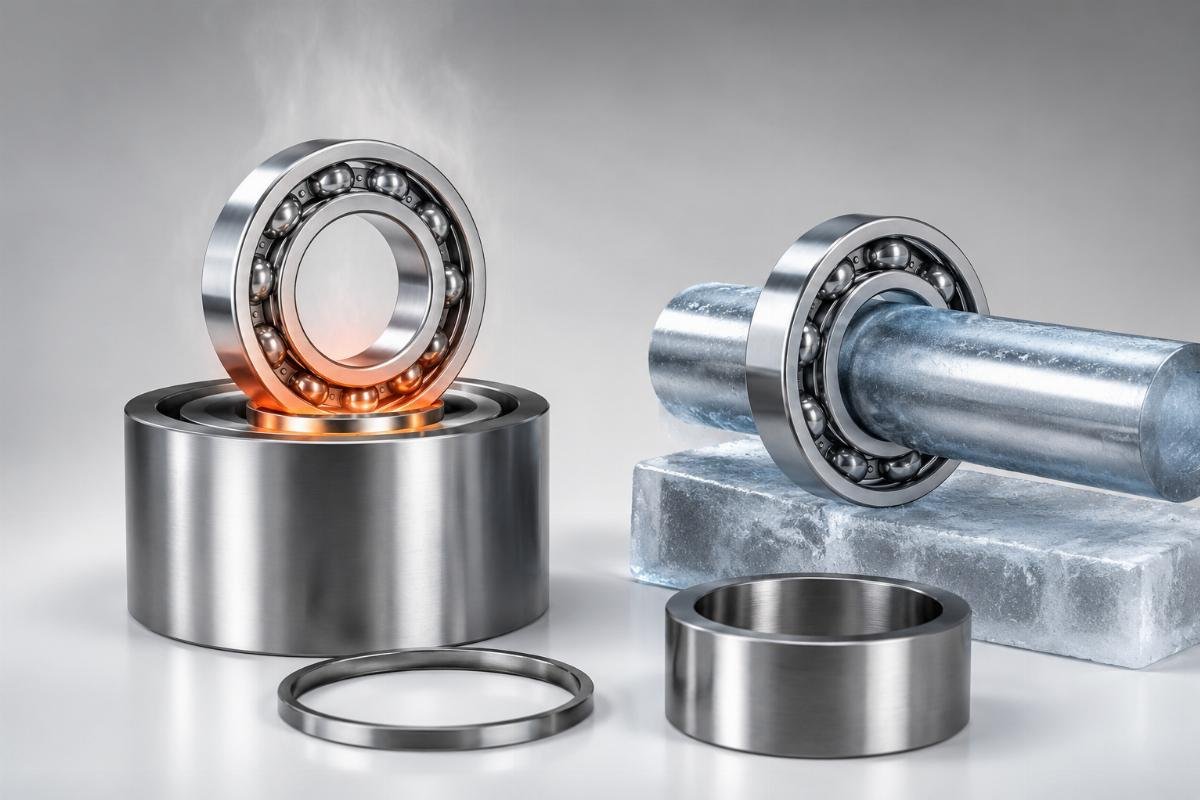
Knowing the mode is where a lasting fix starts. The sections below cover identification, diagnostic method, replacement selection, and the supplier relationship, drawn from work across mills, wind farms, and mine sites.
- Which Failure Modes Do Industrial Bearings Actually Suffer?
- How Do You Get Past a Visual Inspection?
- What Drives the Choice of a Replacement Part?
- How Should Suppliers Be Chosen to Prevent a Repeat?
- Conclusion
Which Failure Modes Do Industrial Bearings Actually Suffer?
Seven modes account for the great majority of industrial bearing deaths. Each leaves a recognizable signature on the metal and in the way the machine behaves, shaping both the repair and the long-term correction. Read the mode wrongly and the replacement will be wrong too, which all but guarantees a second failure.
| Failure Mode | Typical Visual Signature | Common Root Trigger |
|---|---|---|
| Fatigue Failure | Crescent-shaped spalling on raceways or rolling elements | Subsurface crack propagation under cyclic loading |
| Lubrication Failure | Brown or black discoloration, metal-to-metal contact marks | Incorrect lubricant type, insufficient quantity, or additive degradation |
| Contamination | Embedded particles, scratch marks, abrasive wear patterns | Particulate ingress through inadequate sealing or handling |
| Misalignment | Uneven wear concentrated on one side of raceways, cage distortion | Shaft deflection or mounting errors exceeding angular tolerance |
| Corrosion | Rust deposits, pitting, flaking surfaces | Moisture ingress, chemical exposure, or insufficient sealing |
| Overloading | Brinelling marks, raceway deformation | Excessive radial or axial loads beyond rated capacity |
| Improper Installation | Handling marks, cracked rings, brinelling at mounting | Incorrect mounting force, impact damage, or cold expansion errors |
One mill was failing 22324 CA/W33 spherical roller bearings on its conveyor month after month. The visual check suggested ordinary wear, but dimensional work found 0.02 mm of housing bore misalignment that routine rounds never measured. Correcting the bore and taking a full emergency batch on rapid dispatch recovered 8 hours of unplanned downtime each month.
Lubrication damage and fatigue together account for the largest slice of premature deaths, yet teams reach for steel quality as the explanation while a thin film or a dirty environment is doing the damage. Diagnosis has to start with an honest visual classification before anyone settles on a conclusion.
How Do You Get Past a Visual Inspection?
Three disciplined stages, taking the unit apart, cleaning it, then inspecting it, prevent a wrong call in most industrial cases. Judging from what the eye catches sends crews down the wrong path time after time. Real diagnostic value only appears once the physical evidence is set beside condition monitoring history and lubricant analysis.
| Diagnostic Step | Common Mistake | Correct Approach |
|---|---|---|
| Disassembly | Rushing removal with improvised tools, causing secondary damage | Using dedicated pullers, photographing initial condition, and documenting orientation |
| Cleaning | High-pressure water or steam forcing contaminants deeper into surfaces | Ultrasonic cleaning with filtered solvents at controlled temperatures |
| Inspection | Focusing only on obvious macroscopic damage | Measuring dimensional tolerances with calibrated instruments to micron-level accuracy |
| Data Analysis | Ignoring historical vibration and temperature trends | Correlating vibration signatures in the 1-10kHz range with physical findings |
| Root Cause Identification | Stopping at "normal wear" as the conclusion | Tracing failure progression through material certification and lubricant chemistry |
A European wind asset manager brought us a gearbox that kept failing on 230/500 CAK spherical roller bearings. Its own diagnosis blamed manufacturing. Our inspection found grease degraded by incompatible additive packages reacting at working temperature, so we supplied custom-ordered replacements and a rewritten lubrication spec; the gearbox then ran for years without trouble.
Run the diagnostic workflow in this order:
- Dimensional Measurement – Confirm bore, outside diameter, and width against the maker's specification on a coordinate measuring machine. Even a small drift points to mounting damage or heat distortion.
- Material Analysis – Check hardness on the Rockwell C scale and examine the metallurgy to see whether the steel matches its certificate. Hardness that falls away below the surface exposes overheating in service.
- Lubricant Testing – Look for viscosity shift, particulate load, and additive depletion in oil or grease samples using Fourier-transform infrared spectroscopy. When the physical damage is ambiguous, this is the step that names the cause.
- Vibration Analysis – Set pre-failure spectra beside ISO 10816 thresholds and look for abnormal frequency patterns that map onto one defect location.
- Failure Progression Mapping – Put the damage stages in sequence so the origin can be identified as mounting, steady running, or a maintenance intervention.
Crews hurry disassembly to shorten an outage, and the secondary damage contaminates the whole investigation. Pullers, photographs, and orientation marks cost minutes and save weeks of chasing the wrong fault.
What Drives the Choice of a Replacement Part?
A replacement has to answer the cause and the application requirement at the same time. Reordering the same part number without fixing the cause brings most failures back within a short window. Diagnosis is half the job; choosing correctly finishes it.
| Bearing Type | Key Characteristics | Optimal Application Context |
|---|---|---|
| Deep Groove Ball Bearings | High speed capability, low friction | Lubrication-related failures in electric motors and pumps |
| Spherical Roller Bearings | Self-aligning capability, high radial load capacity | Misalignment-driven failures in conveyor systems and gearboxes |
| Tapered Roller Bearings | Combined radial and axial load handling | Overloading failures in mining equipment and heavy axles |
| Cylindrical Roller Bearings | High radial load capacity, separable design | Contamination-related failures in textile and paper machinery |
| Angular Contact Ball Bearings | Precise axial positioning, paired mounting options | Fatigue failures in machine tool spindles |
A procurement manager at a mining operation was fighting grinding mill downtime, because the standard tapered roller bearings kept dying early. Our engineers suggested 32230 tapered roller bearings in the C3 clearance group, with stronger material certification. The bulk order went out quickly, and failure frequency fell sharply, mainly because C3 clearance absorbed thermal expansion the old spec could not.
Once the diagnosis is done, five selection factors need attention:
- Clearance Specification – Match radial clearance (C2, CN, C3, C4) to the working temperature range and the shaft fit. A part that fits perfectly cold can bind badly at running temperature without enough clearance.
- Material Selection – Chrome steel covers most duty, stainless answers corrosive environments, and ceramic hybrids suit very fast running. The mode you identified should drive that choice.
- Cage Design – Brass takes heavy load, polyamide resists chemical attack, and steel tolerates extreme heat. The cage choice bears directly on how a part behaves once dirt or a grease problem appears.
- Sealing Configuration – Contact seals (2RS) guard against dirty environments, while shielded versions (ZZ) are the pick for fast running where friction heat matters.
- Lubrication Compatibility – The internal lubricant must match the system it joins, because incompatible thickeners or additive packages kill bearings quietly and visual inspection rarely catches it.
Whether a rare designation can be obtained often decides whether a sound engineering fix is possible at all. Waiting weeks on a factory lead time for a C4 spherical roller bearing is not an option with a line standing idle.
How Should Suppliers Be Chosen to Prevent a Repeat?
A genuine supplier partnership brings recurrence down sharply when compared with transactional buying. The right partner operates as part of the maintenance engineering team, delivering technical depth, batch-level traceability, and emergency logistics that a generic distributor cannot match.
| Supplier Capability | What to Verify |
|---|---|
| Product Traceability | Full documentation from raw material to finished product, including verifiable batch codes and test certificates |
| Technical Support | Dedicated application engineers with industry-specific failure analysis experience |
| Inventory Depth | Broad stock coverage including rare designations with emergency dispatch capability |
| Quality Assurance | ISO 9001 and IATF 16949 certification with documented inspection at each stage |
| Post-Sale Service | On-site installation guidance, performance monitoring, and proactive replacement planning |
An agricultural equipment dealer network was wrestling with seasonal shortages. Together with us it built a stocking program from years of failure history, timed to planting and harvest. Emergency orders fell dramatically, uptime held through the critical windows, and phased delivery kept just-in-time stock across the regional service centers.
When you assess suppliers for diagnosis support, batch traceability is the line you do not cross. Every delivery should carry batch numbers checkable against manufacturer records, plus origin certificates and inspection documents. Fake and mislabeled parts keep turning up, and diagnostic rigor counts for nothing once one is installed.
Support quality separates a capable partner from a stockist. One who can run L10 calculations, map one maker's clearance class onto another, and feed a root cause investigation adds real value, which matters most to engineers overseeing several sites under different regulators.
Conclusion
Diagnosis is a discipline with steps, not a guessing game. Most recurring failures trace to a root cause someone misread: misalignment taken for wear, degraded grease blamed on bad steel, dirt ignored until the bearing seized. Three stages, careful disassembly, precision measurement, and data correlation, find the true mode, and a replacement chosen for real conditions closes the loop. A traceable supplier then puts the part you specified on the floor.
Need a quote for a specific bearing designation? Our engineers reply within one business day.
Request a quote