
How to Select the Right Bearing for Electric Motors: A China Sourcing Guide for OEMs
A familiar logo on the box does not make a motor bearing the right fit.
Choosing a bearing for an electric motor means weighing three technical inputs, load spectrum, precision grade, and internal clearance, against what the supplier can actually deliver in traceability, engineering support, and logistics. A flawless specification from a vendor nobody can audit will still take a production line down.
I can still picture a warehouse at two in the morning, pulling batch records to prove where a load of deep groove ball bearings had come from. A pump builder in Ningbo had ordered C3 clearance; CN was what got packed. On the bench nothing looked wrong. Only when those motors reached full load at a desalination plant in Dubai did they lock solid, all inside a few weeks. A loss like that is not a catalog error; it is a hole in supply chain control, and what follows here comes from the shop floor and from service visits rather than from a brochure.
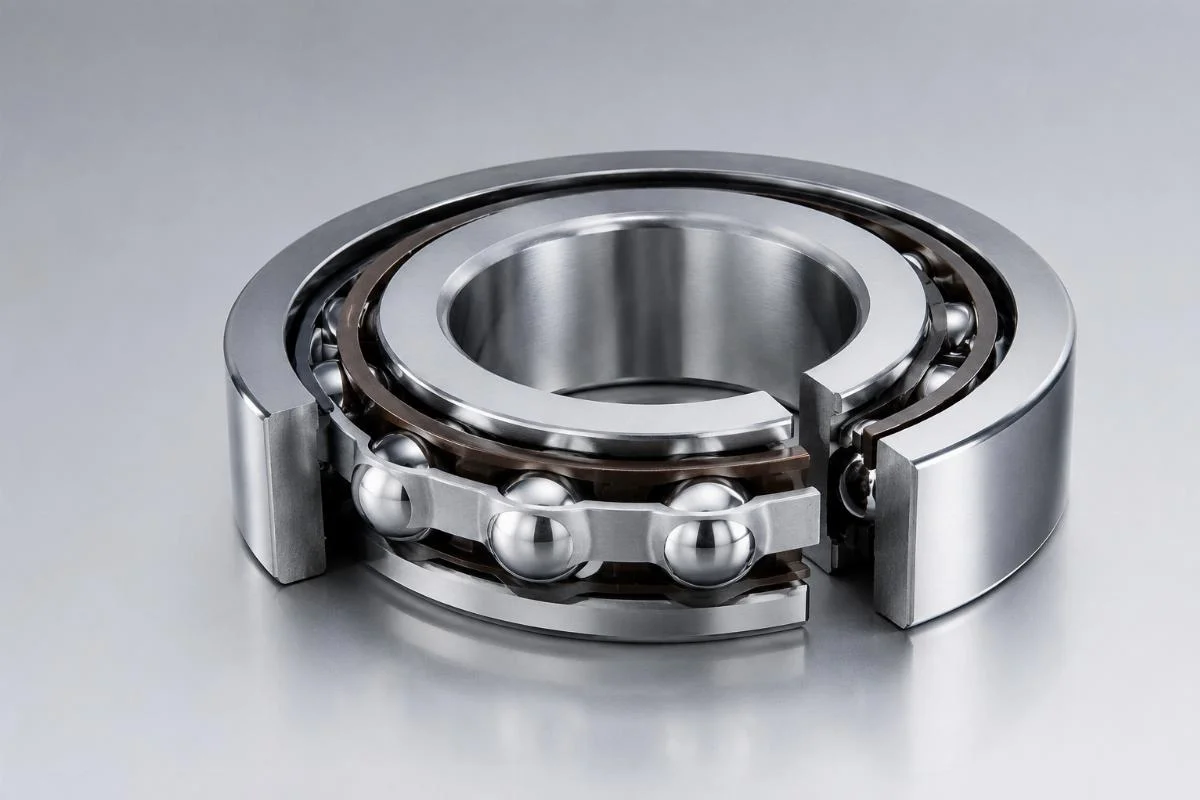
Balancing the technical requirement against what a supplier can prove takes a method, and matching catalog dimensions is only where it starts.
- Which Factors Beyond the Datasheet Shape Electric Motor Bearing Selection?
- What Mistakes Do OEMs Make Most Often When Choosing Motor Bearings?
- How Should an OEM Judge a Bearing Supplier for Motor Work?
- What Step-by-Step Route Gives a Sound Selection With a Chinese Supply Partner?
- Conclusion
Which Factors Beyond the Datasheet Shape Electric Motor Bearing Selection?
Picking a motor bearing is a balancing act between printed parameters and the conditions the machine actually meets. Bore, outside diameter, and width set the starting point, but load split, heat, and the surrounding environment decide whether the bearing reaches its rated hours or dies early.
| Selection Factor | Industry Benchmark Considerations |
|---|---|
| Load Ratio | Radial-to-axial load ratio >3:1 typically requires deep groove ball bearings; ratios <2:1 may necessitate angular contact designs |
| Precision Grade | P5 precision reduces temperature rise noticeably compared to P6 in motors operating above 3000 RPM |
| Material Selection | Stainless steel bearings show substantially longer service life in humid environments compared to standard chrome steel |
| Lubrication | Synthetic lubricants maintain viscosity stability across -40°C to 120°C operating ranges |
A European turbine maker chose standard deep groove ball bearings for its 3 MW generator sets on size and speed alone. Failures began at the 18-month mark. Our engineers mapped the load case and found a substantial axial thrust component coming from wind shear, something the original catalog pick had never accounted for. We proposed swapping the design to angular contact ball bearings, P5 class, with C3 internal clearance; service life rose sharply and running temperature fell. Full qualification took the customer eight months, well inside the twelve-month cycle it had needed with a previous imported brand.
There is a sequence worth following:
- Load Spectrum Analysis – Record radial, axial, and moment loads in genuine service, not the figures from a design note.
- Temperature Mapping – Record how heat distributes across the housing during continuous running, then pick clearance and grease to suit.
- Environmental Profiling – Note humidity, airborne particles, and corrosive exposure before the material specification is fixed.
- Life Calculation – Run ISO 281 load-life equations on measured duty rather than nominal catalog values.
- Precision Matching – Match precision grade to what the motor's tolerances demand, so you are not paying for accuracy the assembly cannot use.
What Mistakes Do OEMs Make Most Often When Choosing Motor Bearings?
Skipping application detail is how a bearing fails early and how lifecycle cost climbs. Plenty of design engineers stop at dimensional interchange and never examine the operating parameters that settle field reliability.
| Evaluation Dimension | Common Mistake | Recommended Approach |
|---|---|---|
| Vibration Consideration | Selecting standard bearings for high-vibration motors | Specifying bearings with reinforced cages and tighter radial clearance for vibration-dampened applications |
| Counterfeit Prevention | Relying solely on price point when evaluating suppliers | Verifying full traceability documentation from raw material to finished product |
| Precision Specification | Automatically selecting the highest precision grade available | Matching precision grade to motor performance requirements; P6 often sufficient for general industrial motors |
| Maintenance Planning | Failing to consider relubrication accessibility | Designing bearing placement with maintenance access and selecting appropriate seals based on service interval requirements |
A steel mill in Southeast Asia lost a motor outright when a batch of 6312 C4 deep groove ball bearings gave up after 45 days. The parts had never been properly heat treated, so the raceway pitted and then seized. The bill ran into six figures for every day the line stood still. Our emergency desk had replacement bearings on site inside 72 hours and then wrote an anti-counterfeit routine for the mill's maintenance team covering material certificate review and laser-mark authentication. Bearing-related downtime fell clearly over the year that followed.
Three mistakes are worth calling out on their own:
- Counterfeit product is a real and costly risk. Bearings bought outside authorized channels can arrive in convincing packaging while lacking the metallurgy of the real thing, so insist on batch-level traceability tied to a certificate you can verify.
- Over-specifying precision burns budget. P5 earns its cost above 3000 RPM where thermal control is tight; a general-purpose industrial motor at moderate speed runs perfectly well on P6.
- A clearance mismatch fails quietly. The Ningbo pump order that opens this article is one example among many: C3 exists to leave room for thermal growth, and shipping CN into a hot application removes that margin, so preload builds, heat rises, and the bearing seizes.
How Should an OEM Judge a Bearing Supplier for Motor Work?
Judging a supplier takes more than reading a catalog. You are assessing engineering depth, traceability infrastructure, and whether the logistics hold when a schedule slips. A good motor bearing partner brings calculation support and supply discipline together.
| Supplier Type | Core Advantages | Optimal Application Scenario |
|---|---|---|
| Authorized Brand Distributors | Full traceability, engineering calculation support, global logistics | OEM production requiring certified genuine products with documentation |
| Specialized Regional Suppliers | Application-specific guidance, shorter lead times for rare designations | Custom motor designs requiring technical collaboration |
| General Trading Companies | Low unit price | Non-critical applications with no traceability requirements |
| Integrated Solution Providers | Multi-component system expertise | Complex motor systems with multiple power transmission interfaces |
An EPC contractor on a large overseas industrial park needed 22320 stainless steel spherical roller bearings delivered in phases across six months, with ISO 9001 compliance and documentation packages clean enough for customs in several countries. Our warehouse network let us position stock ahead of each phase: the first shipment arrived in four weeks and the rest followed on a six-week cycle as planned. Consolidated shipments and complete paperwork cut the contractor's administrative load compared with juggling several vendors.
When you assess a motor bearing supplier, five dimensions carry the weight:
- Technical Capabilities – Can the team run L10 life calculations, walk a load analysis, and propose suitable clearance and precision grades from your application data?
- Traceability Systems – Does each shipment carry batch numbers that can be checked against the maker's records, and can origin certificates and material test reports be produced when asked?
- Inventory Depth for Rare Designations – Can oversize bores, special precision classes, or non-standard clearances ship in days? Factory lead times on uncommon variants often run past a month.
- Freight and Paperwork – Can the supplier handle export paperwork, customs compliance, and DDP, CIF, or FOB terms in the markets you sell into?
- Customization Flexibility – Can it handle laser marking, private-label cartons, pre-greasing to a named lubricant, and translated technical documentation?
What Step-by-Step Route Gives a Sound Selection With a Chinese Supply Partner?
A structured route backed by the supplier's engineers shortens qualification and confirms the bearing suits the application. It lowers technical risk and gets a new motor design to market sooner.
| Selection Stage | Critical Deliverables |
|---|---|
| Requirements Definition | Comprehensive load analysis, operating conditions documentation, performance targets |
| Technical Matching | Bearing type recommendation, precision grade selection, material and clearance specification |
| Supplier Qualification | Quality system audit, production capability assessment, sample testing plan |
| Validation and Certification | Performance testing, lifecycle analysis, documentation review |
| Supply Chain Integration | MOQ negotiation, delivery schedule alignment, inventory management agreement |
A large NEV manufacturer was qualifying a new source for angular contact ball bearings, P5 class with C3 internal clearance, for its electric drive motors. Our engineers began with load calculations to confirm the design, then supplied a sizable sample batch within weeks so bench testing could start. Through qualification we issued a precision report for each batch plus full material traceability. The customer finished validation ahead of its original plan, confident that series production would hold the sample standard.
The five stages run like this:
- Requirements Definition – Collect target service life, ambient temperature and humidity, contamination risk, and the radial, axial, and combined load spectrum, then put them in a specification sheet signed by both engineering and purchasing.
- Technical Matching – The supplier reads your specification and proposes the bearing type, precision class (P0 to P4), clearance group (C2 to C4), and the lubrication method, with L10 life figures calculated to ISO 281.
- Supplier Qualification – Audit the quality system (ISO 9001 or IATF 16949), check traceability procedures, and agree a sample testing protocol; ask for batch papers covering no fewer than three production runs back to back.
- Validation and Certification – Test sample bearings under simulated duty, compare temperature rise, vibration, and noise against a baseline, and record the results for your design review board.
- Supply Chain Integration – Settle MOQ, set a delivery schedule that matches the production plan, and put inventory agreements in place for safety stock, with batch traceability confirmed for future shipments.
Conclusion
Motor bearing selection sits where mechanical engineering meets supply chain management. Precision class, clearance group, load spectrum, steel choice, and grease all have to be matched to real running conditions through disciplined analysis, and the supplier behind the part has to offer traceability you can check, engineering support that answers, and logistics that hold. Whether a motor reaches its design hours or seizes in the field is usually settled long before the part arrives at the assembly line.
Need a quote for a specific bearing designation? Our engineers reply within one business day.
Request a quote